- Optimized Primate Newsletter
- Posts
- Stop Building Ivory Towers in Ball Pits: The 4-Step Process Elite Primates use to Think, Adapt, and Win.
Stop Building Ivory Towers in Ball Pits: The 4-Step Process Elite Primates use to Think, Adapt, and Win.

Luis Arauz
September 28, 2025 • Estimated Reading Time: 18 minutes
Alright, let’s talk about that big, beautiful, squishy brain of yours. You know, that majestic, highly rational decision-making machine, sitting on a fancy velvet throne, contemplating the truth of the universe?
Yeah. No.
That’s some grade-A, organic, free-range horseshit.
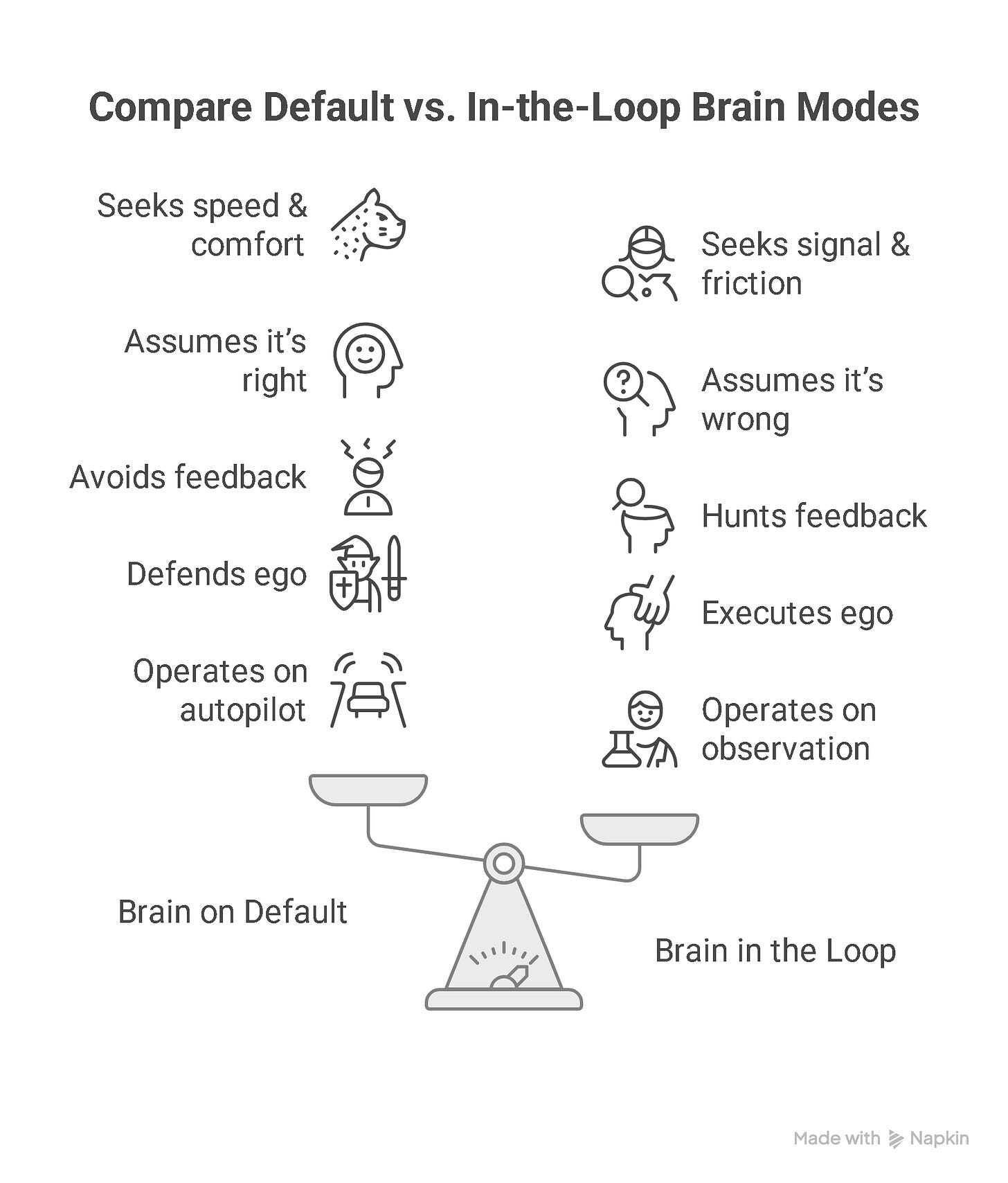
Your brain, by default, is less “King Solomon” and more “King Joffrey”, like a screaming toddler trying to operate a complex hydraulic press while chasing a shiny object.” It’s not built for truth. It’s built for not getting eaten and fitting in with the other chimps so you don’t end up a lonely, saber-toothed tiger snack at the edge of the forest.

That’s it. That’s the evolutionary grand design.
It’s not a disembodied philosopher‑king; it’s a wet scared primate with deadlines. Left on factory settings, the mind leans on biases and shortcuts that trade accuracy for speed. And holy hell, does it show:
Confirmation Bias: Your brain’s personal propaganda minister, ensuring you only hear what reinforces your existing, often dumb, opinions.
Survivorship Bias: Your brain’s clueless motivational speaker, who studies the one billionaire dropout and calls dropping out a brilliant strategy—while ignoring the thousands for whom dropping out meant career stagnation or struggle.
Status-Quo Bias: Your brain’s terrified middle manager, vetoing any change not because the old way is better, but because the new way requires paperwork and might disrupt its nap.
System 1 thinking: That’s your primal lizard brain—what Nobel laureate Daniel Kahneman calls System 1—running on autopilot to justify impulse buys and angry tweets.
Ego: Your brain’s perpetually offended monarch, a tiny king demanding constant flattery, ensuring you’re never, ever wrong—even when you’re demonstrably, tragically wrong.
Along with 180+ other cognitive biases.
These aren’t moral flaws—they’re design constraints. The strategic mistake isn’t having them; it’s what you do once you realize you’re a walking, talking buggy human being.
Most folks never get that far. They get stomped into the fossil record, end up running multibillion-dollar companies into the ground, or get kicked out of public office.
But the ones who do realize their internal wiring is a liability? Well, their first move is to do the most logical, and therefore most idiotic, thing imaginable: they decide to stop having a human brain altogether.
Trap #1: Building a Fortress of Pure Reason
Using the most intricate, logically impeccable mental models, they craft detailed blueprints for a five year fortress, mapping out every corner and accounting for every foreseeable variable and contingency like Dr. Strange seeing every possible outcome with the mind stone.
Really. Who doesn’t love a good fortress?
Except here’s the kicker: you see, that, too, is a trap. A different trap, but a trap nonetheless. Because building a perfect, static system inside a fundamentally imperfect, dynamic world is like designing an exquisite sandcastle in the middle of a hurricane. It looks impressive for a minute. Then the tide comes in. And the tide always comes in.
And that’s the problem with maps, the fucking territory keeps moving.
Your brilliantly crafted five-year plan becomes toilet paper five weeks in, because some unprecedented global event, or a new piece of technology, or just Gary from accounting having a bad Tuesday.
You’ve meticulously crafted a theoretical war machine, but it’s never seen a battlefield. It’s never been stress tested, no data from the field to say, “Hey, genius, your equation works great on paper, but in practice, it just made everyone quit, set fire to the breakroom, and now Gary from accounting is wearing a lampshade.”
And if your “rational” system can’t adapt to the constant changes happening, then it’s not a solution for doing anything, but winning intellectual dick-swinging contests in a vacuum. But don’t think the answer is to swing wildly to the other extreme, because that’s where you find yourself in the next, equally stupid trap:
Trap #2: The Ball Pit of Raw Data
Welcome to the cult of Pure Empiricism, the official religion of hustle culture. It’s the other side of the same broken coin, where “data-driven” fanatics convince themselves that if they just gather enough information, truth will magically crystallize.
And the insidious part is, this feels so responsible. You’re not theorizing; you’re working. You’re frantically diving into what looks like a solid foundation of facts, convinced you’ll eventually hit the bottom and find objective reality.
Newsflash: You’ve just jumped into a children’s ball pit. You’re not finding land. You’re just drowning in hollow plastic.
Here’s why this “just collect data, bro” philosophy is a terminal diagnosis:
First, there’s Information Overload. Remember your King Joffrey toddler brain? Giving it a firehose of unfiltered data is like throwing that toddler into the ball pit. It doesn’t get smarter; it gets paralyzed.
This is the “analysis paralysis” where our friend Gary from accounting spends eighty hours a week generating reports no one reads.
You’re not being agile; you’re flailing in a sea of meaningless plastic, occasionally surfacing with a single, useless red ball, convinced you’ve discovered Atlantis.
Then, there’s Bias Reinforcement. Oh, you think pure “experience” is objective? Adorable. Without a framework to challenge what you’re seeing, you just reinforce your biases.
You keep finding red balls, so you conclude the entire pit is made of red balls, even as you’re standing on a million blue and yellow ones. “It worked last time” becomes your mantra, even when the reasons it worked have vanished like a fart in the wind.
You’re not learning; you’re just confirming what your lizard brain already believed, but now you have a color-coded pivot table to “prove” it.
And finally, you get Zero predictive Power. The ball pit offers a perfect record of the past, but zero insight into the future.
You can describe, with exquisite detail, the color and location of every single ball you’ve already touched. But you’ve got no ability to predict the color of the next ball you’ll grab, or to understand the overall pattern of the pit itself.
You’re not shaping reality; you’re just meticulously cataloging your own random journey through the chaos, hoping you’ll eventually stumble upon the truth.
So, on one side, you’ve got the Ivory Tower Rationalists, dying of thirst in their desert of pure theory. On the other, the Data-Drowning Empiricists, suffocating in a ball pit of uninterpreted facts.
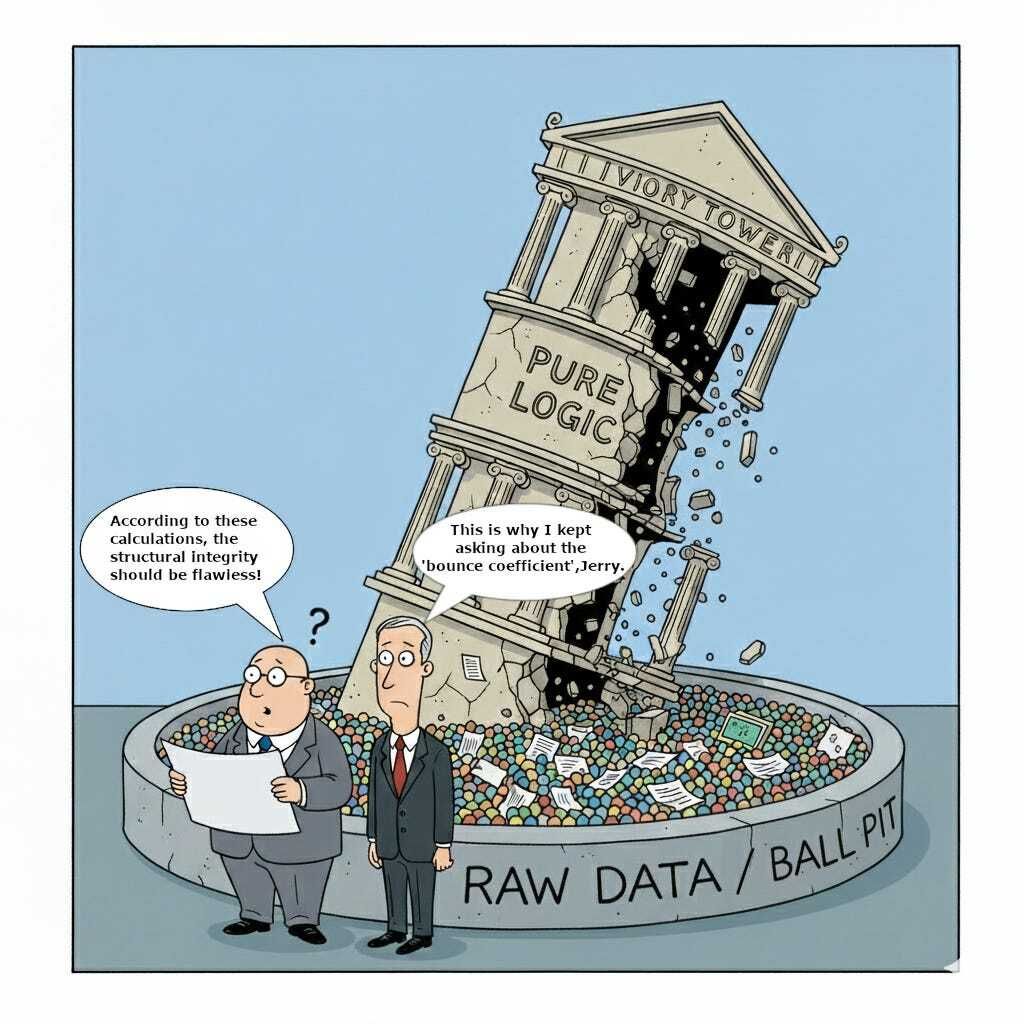
The question isn’t whether to choose the map or the territory. That’s like asking if you prefer oxygen or blood. You need both...
The Solution: The Optimized Primate Operating Loop
So, you’re trapped between a desert of useless theories and a ball pit of raw data. Fantastic. The good news is, the way out isn’t some secret, high-tech escape hatch. It’s a simple, boring, and brutally effective process.
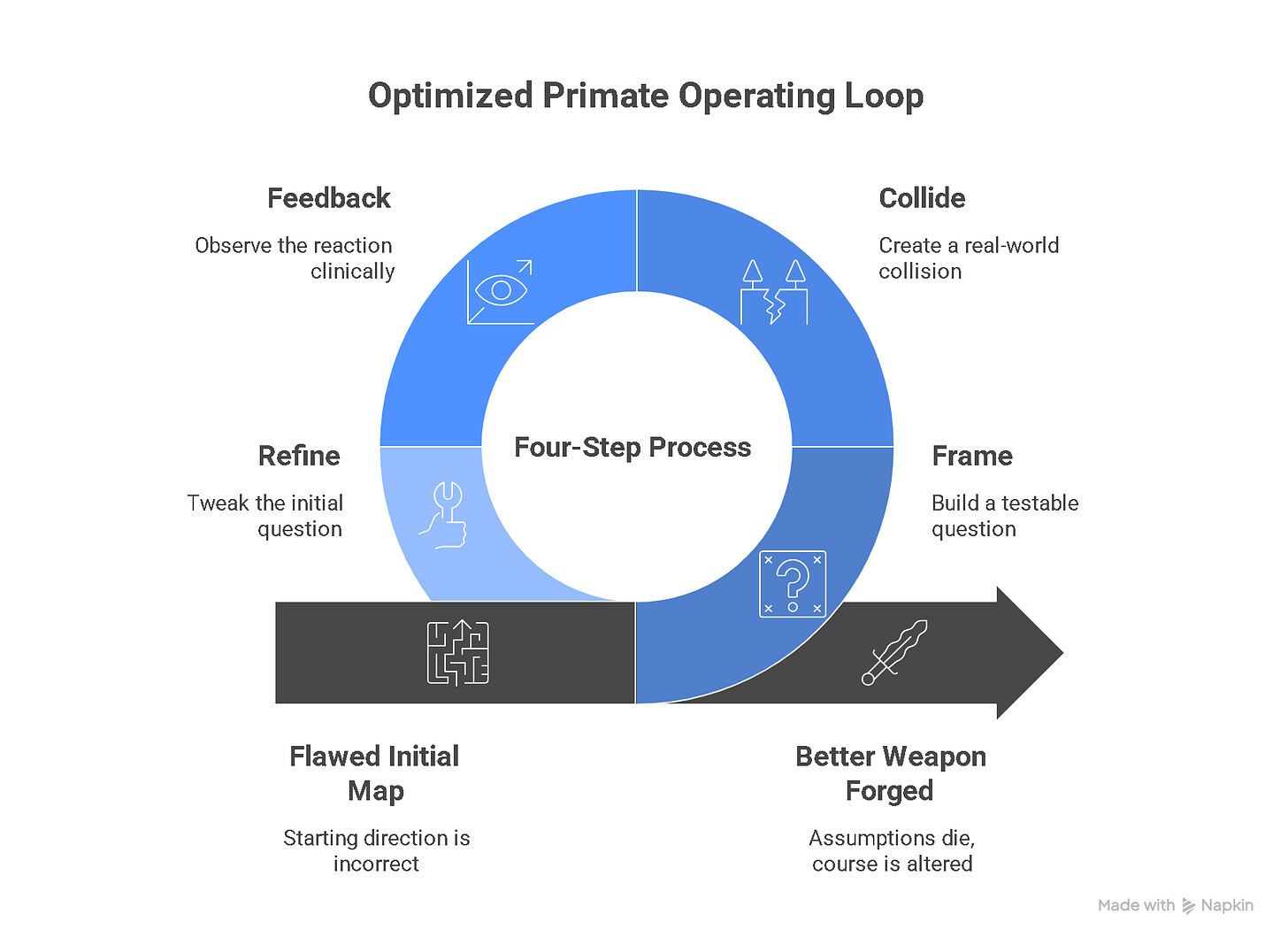
This, my friends, is the Optimized Primate Operating Loop.
And look, we’re not trying to sell you a new religion.
This isn’t some fluffy philosophy. It’s the scientific method with a fancy new paint job and a bad attitude. It’s the engine of military strategy (Boyd’s OODA loop) and disruptive innovation (the Lean Startup’s feedback loop), rebuilt in a back alley to fight dirty.
True mastery isn’t about building an impenetrable fortress of thought. It’s about building a garage, tinkering with your bad ideas until they’re slightly less bad, and occasionally taking them out for a spin to see what falls off.
Step 1: FRAME — Build the Map
(Or: Ask One Good, Stupid Question)
Yes, this is where you bring your best thinking, use reason, and steal lethal mental models. But most of the time, it’s much simpler. It’s about taking your brilliant, world-changing idea and turning it into a simple, testable question.
Before you spend six months building a revolutionary new app for cataloging decorative soaps, the FRAME is asking: “Is my hypothesis—that people are desperate to catalog their decorative soaps—actually true?”
That’s it. You’ve just framed the problem. Assume your initial map is flawed. Its only job is to give you a starting direction.
Step 2: COLLIDE — Punch Reality in the Mouth
(Or: Do One Small, Consequential Thing)
This is the part everyone loves, the “full-contact sport” of execution. But you don’t need to launch a full-scale invasion. You just need to create the smallest possible collision with reality.
Don’t build the soap app. Sketch the main screen on a napkin and show it to three friends. Don’t write a business plan. Send one email to a potential customer.
This isn’t about “manifesting” or “academic masturbation.” It’s about taking one, tiny, real step that forces the world to give you a real response.
Step 3: FEEDBACK — Eat the Data
(Or: Write Down What Actually Happened)
So, you punched reality. It’s probably not even bruised, but it did react. This is where you clinically observe that reaction, separating it from your ego’s desperate need for it to be a good reaction.
Your friends didn’t praise your soap app sketch. They looked confused and asked if you were okay. One of them mentioned they do struggle to remember to water their houseplants.
That is the data. Not your interpretation (”they’re jealous of my genius”), but what literally happened.
The feedback isn’t a 50-page report from Gary in accounting. It’s one or two sentences written on a post-it note: “Friends don’t care about soap. One mentioned houseplants.” That’s it. You’ve just eaten the data.
Step 4: REFINE — Forge a Better Weapon
(Or: Tweak the Stupid Question)
You take the data—your bloody, tear-stained post-it note—and you let it change your mind. This is where the old, dumb assumptions die.
You don’t need to go back to the drawing board and invent a whole new weapon. You just slightly alter your course. You take the feedback and use it to ask a slightly less-stupid question.
Your old hypothesis was about soap. Your new one, forged in the crucible of awkward conversations, is: “Is my new hypothesis—that people will pay for an app that reminds them to water their goddamn ficus—true?”
...And then? You repeat the loop. Relentlessly.
This isn’t just “iteration,” it’s antifragility as a core operational principle. Your system doesn’t just survive stress; it gets stronger because of it. It’s dynamic, not static. It has humility baked into its very core, assuming the initial map is always flawed. You’re not trying to eliminate mistakes; you’re building a process that profits from them. So you can become an ‘Optimized Primate’ to survive systems built by other primates who didn’t use this loop.
A Quick Word on Your Bugs (And Why They’re Sometimes Features)
Now, let’s be clear. Not every bias or gut feeling is a bug to be squashed.
Sometimes, your gut is just high-speed pattern recognition you’ve earned through thousands of hours of experience. And sometimes, as researchers like Gerd Gigerenzer have shown, a simple mental shortcut is faster and more effective than a complex analytical model.
The point of the loop isn’t to replace your intuition or to turn you into a logic-spewing robot. It’s to have a reliable process for when the stakes are high, the territory is new, or your gut is screaming at you to do something objectively stupid, like texting your ex at 2 AM.
Think of this process less like a meat grinder you have to fire up for every battle, and more like a steering wheel. It’s how you stop being a passenger in a chaotic world.
You don’t have to bend reality to your will; you just have to make the tiny, constant, boring corrections that keep you from driving straight into a ditch.
But keeping your hands on the wheel is harder than it sounds, especially when your ego, your biases, and that inner King Joffrey are all screaming at you to let go and pray.
That’s why you need guardrails.
The loop is the process, but the following five rules are the non-negotiable mechanics that keep the whole machine on the road.
1. Embrace the “Scientific Method” for Your Life
The Action: Treat your ideas like lab rats, not children.
The Rationale: This isn’t about wearing a lab coat. It’s about treating your most cherished strategies not as sacred identities to be defended to the death, but as cheap, disposable hypotheses to be tested to destruction.
Is your “game-changing” business plan a work of genius?
Who gives a shit. Frame it, run the test, and be ready to execute it in a dark alley if the data says it sucks.
2. Build External Scaffolding
The Action: Outsource your objectivity.
The Rationale: Your brain is a fundamentally unreliable narrator—a biased, egotistical, story-telling machine. You need to build systems outside of it to keep it honest. This is your external brain, the scaffolding that forces objectivity when your internal wiring screams for self-preservation. We’re talking:
Checklists for repeatable processes.
Mandatory pre-mortems where you assume the project has already failed spectacularly and explain why.
A designated “devil’s advocate” whose only job is to tell you why your plan is stupid.
3. Hunt for Disconfirming Evidence
The Action: Actively try to prove yourself wrong.
The Rationale: Your brain is addicted to the cheap high of confirmation bias. Your job is to be the narc.
Become a relentless hunter, not for validation, but for evidence that proves your beautiful theory is wrong.
The fastest way to find the truth isn’t to build a case for why you’re right; it’s to try your absolute damnedest to destroy your own case, and fail.
4. Cultivate Deliberate Reflection
The Action: Schedule a cold, hard autopsy for your results.
The Rationale: This isn’t some mindful, kombucha-sipping journaling session. You have to block out time on your calendar to sit down with the bloody results of your collision with reality.
There is only one question that matters: “Where, precisely, was my map wrong?”
Don’t ask who was to blame. Ask what part of your model was pure, unadulterated bullshit.
This is where the real learning happens.
5. Prioritize Data Over Dogma
The Action: Let reality change your goddamn mind.
The Rationale: This is the Prime Directive. Reality is your only editor. It doesn’t care about your ideology, your feelings, or your five-year plan.
It will hand you the unvarnished, often brutal, results. Your only job is to have the courage to look at them, accept them, and act accordingly.
The map must always bend to the territory.
When the Loop Goes Sideways: 3 Signs You’re Breaking the System
Now, like any powerful tool—a chainsaw, a sports car, a Twitter account—it’s entirely possible to use this loop in incredibly stupid ways. The goal is to be brutally effective, not just brutally busy. Watch out for these failure modes:
Loop Fatigue (Mistaking Motion for Progress):
This is when you become addicted to the cycle itself. You’re constantly tinkering, testing, and refining, but you never zoom out to ask, “Am I solving the right problem?” You’re so focused on forging a “better weapon” that you don’t realize you’re in the wrong war entirely. You’re iterating on the font color of your decorative soap app instead of questioning if anyone wants to catalog soap.
Micro-Pivot Hell (Overreacting to Noise):
This is the opposite of confirmation bias, and it’s just as dangerous. You treat every single data point as a divine commandment. One person dislikes your landing page, so you redesign the whole thing. Ten people open your email but only two click, so you scrap your entire marketing strategy. You’re forgetting that most feedback is noise, not signal.
Analysis Paralysis, Reinvented (Perfecting the Map):
This happens when your “Frame” step becomes its own Ivory Tower. Your “testable question” balloons into a 50-page research project before you’ve taken a single step. Remember: the goal is to create a small collision with reality, not to write a doctoral thesis before you’ve even left the lab.
So what’s the big takeaway here?
Is this the part where I sell you the 7 Secrets of Flawless Rationality for just $99.95? The part where I reveal the one weird trick, discovered by a Silicon Valley guru on a silent ayahuasca retreat, to finally debug the screaming King Joffrey toddler that lives in your skull?
No. Because that’s a lie.
That’s the kind of garbage peddled by the same people who think you can solve systemic inequality by just having a more positive mindset. Anyone selling you a cure for the human condition is a con artist, and you should take their wallet.
The Optimized Primate framework doesn’t fix the hardware. The hardware is a glitchy and magnificent mess. This isn’t a brain transplant. It’s a better user manual.
So maybe, think of it less like forging a legendary weapon and more like brushing your teeth.
It’s not glamorous. It’s a boring, repetitive, and absolutely non-negotiable piece of mental hygiene. You do it because you know what happens if you don’t: everything slowly, painfully rots.
So how often do you run the loop?
It’s not a rigid schedule; it’s a set of simple rules of engagement:
When the stakes are high, loop more. Don’t just “trust your gut” on the big decisions. The bigger the bet, the more you test.
When you’re stuck, loop faster. If you’re paralyzed, your loops are too big. Shrink them. Run smaller, quicker experiments to break the inertia.
When feedback shatters your beliefs, slow down. That’s not noise; that’s the signal you’ve been hunting for. Zoom in. Interrogate the wreckage.
Because right now, the world is absolutely full of people with rotten thinking, and unfortunately, many of them are in charge of very, very important things.
So stop chasing the myth of the lone genius. Stop drowning in the corporate ball pit. The real work is the boring, endless, and essential loop. Ask the question. Run the tiny experiment. Look at the result without lying to yourself. And then tweak the question.
Because the goal isn’t to “win” by having one brilliant, flawless idea. The goal is to keep playing the infinite game a little smarter each time. It’s not about being the smartest primate in the room. It’s about being the most adaptable one who consistently flosses.
And in a world of intellectual decay, that is a revolutionary act.
Reply